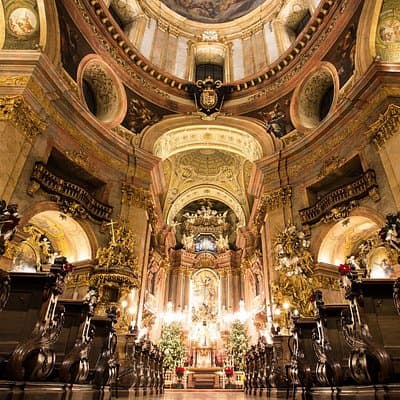
Concierto clásico en la Iglesia de San Pedro en Viena
4.72467 opiniones1h
desde 39 €
Ver disponibilidad
Austria
Vienna is a city that demands you slow down. This isn't a place for rushing between sights—it's a place for lingering over a melange in a wood-paneled coffee house, losing yourself in the Kunsthistorisches Museum, or watching the evening light gild the Ringstraße. The Habsburg capital may have lost its empire, but it kept its grandeur.
The Austrian capital is a symphony in architecture: Baroque palaces parade alongside Jugendstil apartments, Gothic spires pierce the sky near modernist museums, and the grand Ring Boulevard circles the old town like a greatest-hits album of 19th-century building styles. Everywhere you turn, the past is present—not preserved in amber, but actively lived in.
Yet Vienna is no museum piece. This is the birthplace of psychoanalysis, the city where Klimt scandalized society, where Schiele pushed boundaries, where the Vienna Secession declared war on artistic tradition. That innovative spirit persists in contemporary galleries, in the electronic music scene, in the ambitious redesign of the Museumsquartier. Vienna honors its past while quietly revolutionizing its future.
Experience imperial grandeur at its peak—from Schönbrunn Palace to the Hofburg, Vienna's Habsburg heritage is breathtakingly preserved and genuinely inspiring.
Discover world-class museums, including the Kunsthistorisches with Vermeer and Bruegel, the Leopold with Schiele, and the Belvedere with Klimt's Kiss.
Join the ritual of Vienna's coffee house culture—a UNESCO intangible heritage where newspapers come on wooden rods and sitting for hours is expected.
Attend classical music performances in the city where Mozart, Beethoven, Brahms, Mahler, and Schubert composed—from opera houses to intimate chamber concerts.
Explore the Naschmarkt and wine taverns (Heurigen) that reveal Vienna's sensual side—beneath the formal exterior lies a city devoted to earthly pleasures.
Walk a city consistently ranked among the world's most liveable—clean, safe, efficient, and green, yet never sterile or boring.
¿Listo para explorar Viena?
The historic heart within the Ringstraße, packed with imperial palaces, Gothic churches, and grand coffee houses. St. Stephen's Cathedral anchors a warren of pedestrianized streets mixing museums, shops, and hidden courtyards.
Highlights:
Best for:
Vienna's hippest neighborhood, centered on the Spittelberg quarter with its Biedermeier houses, boutique shops, and buzzing café scene. The MuseumsQuartier's contemporary art spaces anchor this creative district.
Highlights:
Best for:
Across the Danube Canal, this former Jewish quarter is now Vienna's most diverse neighborhood. The Prater park, Karmelitermarkt, and emerging restaurant scene attract those seeking authentic Vienna beyond the tourist center.
Highlights:
Best for:
Residential neighborhoods south of the center with Vienna's best local food scene. The Naschmarkt stretches along their border, while quiet streets hide wine bars, design shops, and authentic restaurants.
Highlights:
Best for:
Los tours y entradas que más reservan los viajeros, con valoraciones y opiniones de Viator.
desde 39 €
Ver disponibilidad
desde 78 €
Ver disponibilidad
desde 63 €
Ver disponibilidad
desde 71 €
Ver disponibilidadTours y precios de Viator, una empresa de Tripadvisor. Los precios cambian según las fechas. Podemos recibir una comisión si reservas, sin coste extra para ti.
Viennese cuisine reflects the empire it once ruled—a melting pot of Austrian, Hungarian, Czech, and Italian influences. The famous schnitzel, the elaborate pastries, the coffee house cakes—all exist within a tradition that prizes quality and presentation. Add excellent wine from surrounding vineyards and you have one of Europe's most satisfying food cultures.
Wiener Schnitzel is traditionally veal. Pork schnitzel should be called 'Schnitzel Wiener Art.' Real schnitzel is fried in clarified butter.
Order a 'Melange' (similar to cappuccino), read the newspaper (on wooden rods), and stay as long as you like. That's the tradition.
Viennese cakes are elaborate art forms. Don't skip Kaiserschmarrn or Palatschinken (crepes) for lighter options.
Look for a pine branch above the door—it means they're open. Bring cash, order wine by the Viertel (quarter liter), and fill your plate at the buffet.
Vienna blossoms spectacularly—cherry trees in parks, outdoor terraces reopening, and the city shaking off winter's formality. Easter markets and concerts mark the cultural awakening.
Pros:
Cons:
Long days and outdoor festivals transform the city. Opera performances move to giant screens on the Rathausplatz, Danube beaches fill with swimmers, and Heurigen gardens are at their best.
Pros:
Cons:
Perhaps Vienna's most magical season. The musical season opens with world premieres, vineyards glow golden, new wine (Sturm) flows at Heurigen, and the parks turn spectacular colors.
Pros:
Cons:
Vienna transforms into a winter wonderland. Christmas markets fill every square, the balls season brings waltzing to palaces, and concert halls offer refuge from the cold.
Pros:
Cons:
Compara precios de trenes, autobuses y vuelos a Vienna
Introduce tu ciudad de salida para ver precios

1 hour by train to Krems or Melk
A UNESCO-listed stretch of the Danube lined with vineyards, baroque abbeys, and medieval villages. Cruise between Melk's magnificent monastery and Krems, stopping to taste Grüner Veltliner at cellar doors.
2 hours 20 minutes by train
Mozart's birthplace and Sound of Music filming location, with a stunning old town beneath a clifftop fortress. Doable as a day trip but worth an overnight to properly explore.
1 hour by train or boat
Slovakia's capital is just down the Danube—Europe's closest pair of capital cities. A charming old town, castle views, and cheaper prices make it an easy half-day excursion.
Vienna is not cheap, but excellent public services and free attractions balance the costs. Coffee house culture and Heurigen offer affordable pleasures; major museums have free or reduced entry days. Transportation is efficient and reasonably priced. Smart planning means you can experience imperial grandeur without an imperial budget.
Budget
€60-90
per day
Mid-Range
€120-180
per day
Luxury
€300+
per day
One of Europe's largest cemeteries and surprisingly atmospheric, with Art Nouveau graves, the Musicians' Quarter (Beethoven, Brahms, Schubert, Strauss), and beautiful autumn colors.
Far from being morbid, this is a peaceful park where Viennese take Sunday strolls. The musician graves are pilgrimage sites, and the old Jewish section is hauntingly beautiful.
Whimsical apartment buildings designed by artist Friedensreich Hundertwasser—undulating floors, trees growing through windows, colorful ceramic tiles rejecting straight lines.
A delightful contrast to imperial Vienna, showing the city's creative side. The nearby museum has his original works and rotating contemporary exhibitions.
A private museum dedicated to the classic film noir shot in post-war Vienna, with original props, sewer tours, and documents from the four-power occupation.
The most eccentric museum in Vienna, run by passionate collectors. The rooftop zither concert and sewer tour recreate the film's atmosphere perfectly.
A stunning Art Nouveau greenhouse in the Burggarten, now home to a stylish café-restaurant with botanical surroundings.
Breakfast among the palm trees feels like a secret garden. The imperial greenhouse architecture is magnificent, and the location behind the Hofburg is perfectly central.
Allegedly Europe's oldest restaurant (803 AD), hidden in a courtyard near St. Peter's Church, with vaulted medieval cellars and surprisingly good food.
Tourist crowds miss this genuinely ancient restaurant just steps from St. Stephen's. The atmosphere in the cave-like lower rooms is unmatched.
Viennese culture values tradition, formality, and the arts. The city takes itself seriously—dress codes matter, classical music is a religion, and coffee house etiquette has UNESCO protection. Yet beneath the formality lies warmth; once trust is established, Viennese hospitality is genuine. Expect politeness, respect privacy, and embrace the slower pace.
Exceptionally safe—consistently ranked among the world's safest cities. Petty crime exists (watch belongings at tourist sites) but is rare. Solo travelers and women feel very comfortable. Public spaces are well-lit and policed.
Three days covers the imperial highlights—Schönbrunn, Hofburg, museums, and coffee houses. Five days allows deeper exploration of neighborhoods and a day trip. A week lets you experience the musical calendar and adopt the Viennese pace.
Absolutely. The Vienna Philharmonic, State Opera, and Musikverein attract global talent year-round. Even non-enthusiasts should attend something—standing room is cheap, and the architecture alone is worth it. Mozart house concerts feel touristy but aren't bad.
The 1st District (Innere Stadt) for first-timers and imperial sights. Neubau (7th) for contemporary culture and hipster vibes. Wieden/Margareten (4th/5th) for foodie access. Leopoldstadt (2nd) for local atmosphere and Prater proximity.
No—they're formal and reserved, which can seem cold. Use polite greetings, respect personal space, and don't expect immediate warmth. Once you're established as a regular at a coffee house or shop, genuine friendliness emerges.
Yes—performances (expensive, €25-200), training sessions (€15-18, more accessible), and tours (€18) are available. Book performances weeks ahead. Training sessions give you the famous Lipizzaner horses in the beautiful hall without the crowds.
The cake is the same quality as at Demel (both claim the original recipe). Hotel Sacher has the name and history but also queues and higher prices. Demel offers similar elegance with shorter waits. Both are worth trying once.
April-May for spring blooms and Easter. September-October for wine harvest and concert season opening. December for magical Christmas markets (but crowded). Summer has outdoor festivals but the major music institutions are on break.
Costes diarios habituales para un viajero, de económico a cómodo.
| Económico | Gama media | Cómodo | |
|---|---|---|---|
| Alojamiento (por noche) | 55 € | 130 € | 220 € |
| Comida y bebida (por día) | 18 € | 38 € | 75 € |
| Visitas y actividades (por día) | 10 € | 25 € | 55 € |
| Total por día | 83 € | 193 € | 350 € |
Las estimaciones no incluyen vuelos ni transporte de larga distancia. Compara los costes diarios entre ciudades
Hoteles cerca del centro de Viena, de económicos a lujo. Los precios son tarifas por noche habituales en nuestra última consulta.
 Económico
 Económico
 Gama media
 Gama media
 Superior
 Superior
 Lujo
 Lujo
Los precios de hotel proceden de Traveloka, consultados por última vez el 4 de febrero de 2026, y varían según tus fechas. Podemos recibir una comisión si reservas a través de nuestros enlaces, sin coste adicional para ti.
Conexiones populares en tren, autobús y avión, con tiempos de viaje y tarifas.
Deja que la IA cree el itinerario perfecto para tu viaje a Viena. Solo describe lo que quieres experimentar.
Planificar viaje a Viena